How much public liability cover do I need?
Usually, whoever asks for proof of your cover sets the number. Insurers sell three standard limits, $5 million, $10 million and $20 million; council permits and site owners most often ask for $20 million, licences that set a minimum sit at $5 million, and government contracts run $10 million to $20 million depending on the risk of the work.
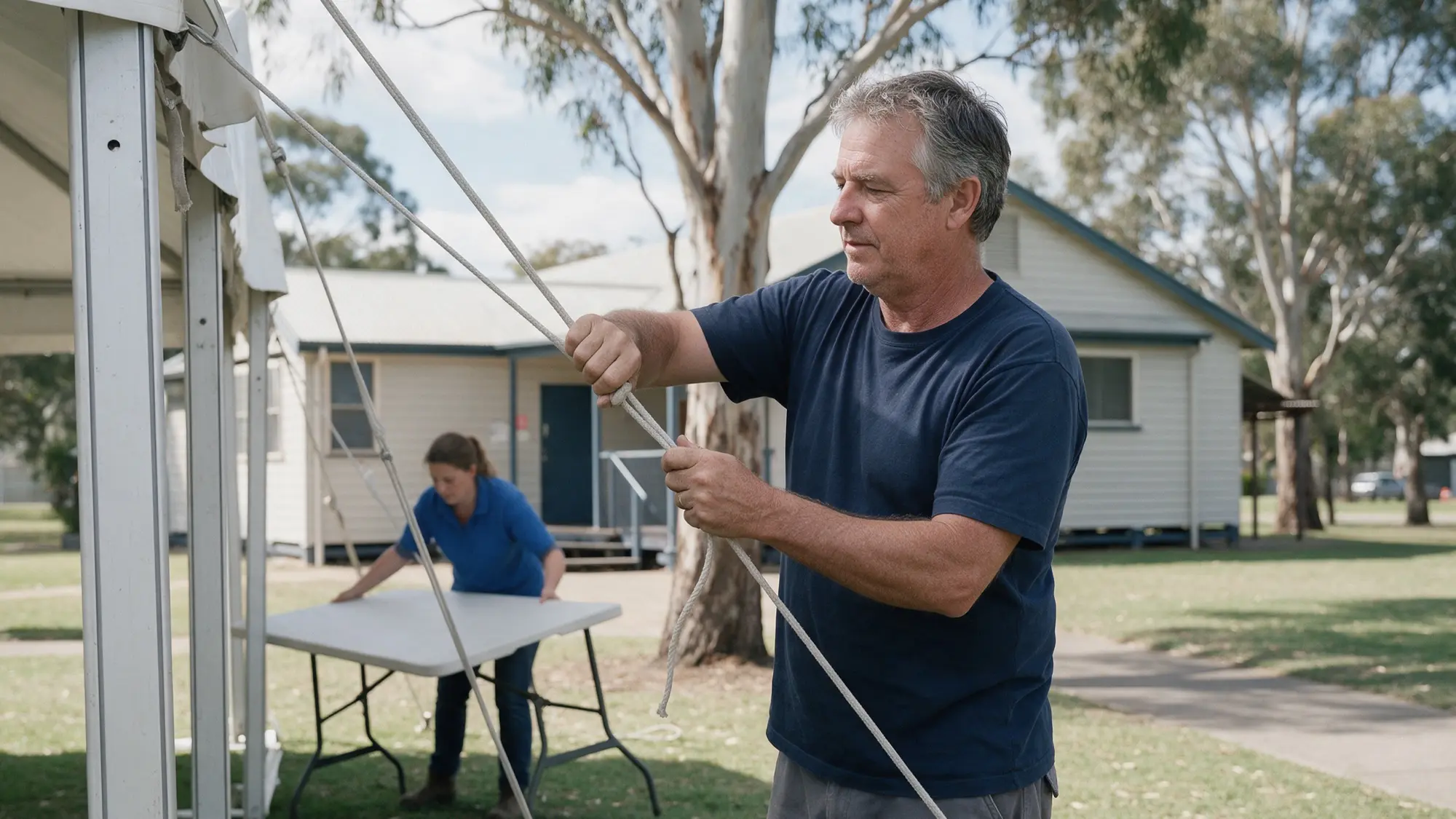
Three limits, and who picks the number.
Insurers sell the cover in three sizes. The size you’re asked for usually comes from someone else’s paperwork.
- $5 million, $10 million or $20 million Insurers’ public pages offer the same three limits1, 2. One puts it plainly: there is “no ‘one size fits all’ rule” for how much a business needs, and some corporate and government contracts stipulate a minimum1. How the limit itself works is on our public liability page, along with published prices by limit.
- Not a legal minimum We found no general law that sets a public liability limit. The figures come from licences that make it a condition, and from the permits, contracts and leases you work under. A NSW council’s fact sheet for small business puts the usual thinking this way: a small business “may be quite adequately covered with a $5 million policy, but a medium to large business with more substantial risks may require cover of $10 to $20 million”3.
- Where the asks cluster The builders’ association describes public liability as, for practical purposes, mandatory for licensed builders, with “a general minimum $5 million” and “$10 million to $20 million” for commercial or larger projects4. The Insurance Council’s position is that requirements “should be limited and scaled to what is reasonably required based on the activities being undertaken”5.
What councils ask for.
Permits for stalls, events, hire and footpath trading, from published council pages in every state. $20 million is the usual figure.
- Victoria The City of Melbourne wants cover “for a value of at least $20 million for a single claim” for any permit to use public space, with the council named as an interested party6. Nillumbik asks for a minimum of $20 million for a street stall or fundraising permit7. Wyndham runs its own scheme for casual hirers of council facilities, with a $20 million limit and a $500 deductible per claim8.
- New South Wales Bathurst’s policy applies $20 million to “all contractors, subcontractors, event promoters”, leaseholders, stallholders and hirers, rises to $30 million for speed events at Mount Panorama, and lets the council take insurer advice before accepting less for minor works under $20,0009. Singleton’s tenderers need “$20 million Public Liability Insurance noting the interests of Singleton Council”10, and Wollongong wants events “fully covered to the amount of $20 million”11. One council’s footpath dining approval asks for not less than $10 million, or $20 million on state roads12.
- Queensland Events in Brisbane’s listed parks and bridges need insurance with “$20 million coverage per incident”13.
- Tasmania, WA and SA Clarence City wants a policy “of a sum not less than twenty million dollars” for events on council land14. Belmont’s stallholder permit needs $20 million, endorsed in the council’s name if you put up a marquee15, and Port Hedland’s contractor terms want “not less than $20 million for any one occurrence”16. Mitcham asks for $20 million for a wedding, funeral or special event permit17, while Wakefield Regional Council sets $10 million for activities on council land18.
The council usually wants a certificate of currency before it issues the permit9, 12, and sometimes wants to be named on it as an interested party6, 9.
Government contracts and tenders.
States set the figure by the risk of the work, and some policies now push agencies to ask small suppliers for less.
- Queensland The whole-of-government guide’s example table runs from “no less than $10 million” for low and medium exposure to $20 million for high and $50 million for very high, and the guide stresses the table is an example only19. Its minor works contract makes the contractor hold public liability “for an amount not less than the amount stated in the Annexure”, with evidence of insurance on request23.
- ACT A determination in force since 2005 sets $10 million where an activity’s insurance risk rating is 6 or below and $20 million where it is 7 or above, unless the ACT Insurance Authority allows less20.
- New South Wales The Procurement Board directs agencies to “ensure the minimum possible levels of public liability and professional indemnity insurance are imposed on small (and medium) businesses”, and to ask for insurance details only at contract award21. In the GC21 construction contract, the public liability figure goes in the contract information, and in the ACT’s version “$20 million in respect of each claim” applies if the item is left blank22.
- Victoria and WA Victoria’s Department of Education sets its minimum for contractors at $10 million24. WA’s procurement guideline sets no figure: agencies size insurance to the “maximum probable loss” of the contract, and are warned that “excessive insurance requirements can also potentially dissuade suppliers from submitting an offer”25.
Licences that set a minimum.
A handful of licences make a public liability limit a condition of holding them. These are the ones with a published figure.
- Electrical contractors: $5 million Queensland requires public and products liability with “a limit of indemnity of at least $5,000,000, and consumer protection insurance of at least $50,000”26. Victoria’s registered electrical contractors need a minimum of $5 million, and Energy Safe Victoria notes it is an offence to carry on electrical contracting without the prescribed insurance27. Tasmania and the Northern Territory also require at least $5 million28, 29. Western Australia asks for civil liability insurance without naming a figure29. See our electrician insurance page.
- Victorian plumbers: $5 million Licensed plumbers must hold public liability with minimum cover of $5,000,000, with the certificate noting it complies with the Licensed Plumbers General Insurance Order30.
- NSW security: $10 million A master licence that provides armed guards or guard dog handlers needs at least $10 million31.
- Queensland childcare: $10 million The 2026 regulation prescribes public liability insurance of at least $10 million for approved education and care services32.
Most trade licences have no public liability condition at all: the public liability page lists the NSW building, Queensland QBCC and South Australian licences we checked. Those licences have other insurance rules, such as home warranty cover.
Landlords, sites and platforms.
The number can also come from a lease, a site induction or the platform you find work through.
- Shopping centres and sites We found no shopping centre that publishes its figure. An insurer’s own guidance to customers says “many large shopping centres require a minimum of $20m cover from their tenants, even if only for short-term pop-up store”, and that some building sites set a minimum before you can work on them33.
- Standard building contracts The builders’ association’s kitchen, bathroom and laundry contract in WA requires the installer to take out public liability “with a cover of at least $5 million”34. Government forms put the amount in a schedule or annexure and ask for evidence before work starts22, 23. Our clause decoder explains the terms that come with it.
- Gig platforms Airtasker’s policy gives taskers $10 million of third-party liability cover for injury or damage while performing a task, on a claims-made basis with a 30-day lodgement window, and says the tasker is still primarily accountable35.
Reading the number on a policy.
Published wordings show what a limit does and doesn’t include. Yours may differ, so check the schedule.
- Any one occurrence In one broadform wording the public liability limit is the most paid “in respect of any one Occurrence”, while the products liability limit is the most paid for all occurrences in the policy period36. Everything “attributable to one source or original cause” is one occurrence36, so several people hurt in one incident share the limit. Queensland’s procurement guide says the same: the limit “is reinstated for each new occurrence”19.
- Legal costs, inside or outside That wording pays defence costs in addition to the limit, but stops paying once the limit is exhausted, and cuts them back in proportion if a claim exceeds the limit36. Victoria’s community service wording pays costs “in addition to the Limit of Liability” too37, but its master wording counts compensation and defence costs together inside the limit, and even inside the deductible38. Two policies with the same $20 million on the certificate can behave differently.
- The excess The limit sits above the deductible, which applies once per occurrence however many claims flow from it36.
- Principal’s indemnity and cross liability When a contract asks for the principal to be covered, the wording extends “Insured” to a principal “only to the extent required by such contract or agreement”, and only up to the policy’s limit36. A cross liability clause treats each insured party as if separately insured, but “nothing contained in this clause will operate to increase the Insurer’s liability”36. The Insurance Council warns that broad contractual indemnities “would typically not be covered” by public liability at all5.
If you hold less than the contract asks.
It’s a contract problem, with contract remedies. The pressure to ask for less is growing.
- What the other side can do Under GC21 the contractor must prove its policies are current before starting work, and if it doesn’t, the principal may take out the insurance itself and recover the premiums and its costs as a debt22. Councils simply don’t issue the permit until the certificate arrives9, 12.
- Where $20 million came from No official source explains it. The ACT has used $20 million as its default for government land since 200320. In 2025 an ACT Assembly inquiry reported that for some community organisations the $20 million requirement “can prove to be too onerous for them to conduct their activities at government facilities”39, and the Insurance Council has asked governments and councils to review the insurance requirements in their standard agreements5.
- Asking for less Some policies allow it: Bathurst takes insurer advice before accepting a lower amount for minor works9, the ACT Insurance Authority can set a lesser amount20, and NSW agencies are directed to ask small businesses for the minimum possible21. Whether a particular client will agree is a question for that client.
A broker reads the clause against your policy and arranges the limit the contract needs. The quote request on our public liability page goes to one approved broker, free, and that broker contacts you. If you work alone, our guide to sole trader insurance covers what the law does and doesn’t require.
Common questions.
How much public liability insurance do I need in Australia?
There’s no general legal minimum. The number usually comes from whoever asks for proof of your cover: councils and site owners most often ask for $20 million, government contracts set $10 million or $20 million by the risk of the work, and licences with a minimum, such as electrical contractors in Queensland, Victoria, Tasmania and the NT, sit at $5 million. Check every permit, contract and lease you work under, and ask your broker to read the clause.
What is the difference between $10 million and $20 million public liability?
The most the insurer pays for any one occurrence. Both limits usually reset for each new occurrence, and products liability usually has a yearly total as well. Whether legal costs come out of the limit or are paid on top depends on the wording.
Why do councils ask for $20 million public liability?
No official source explains where $20 million came from. The ACT has used $20 million as its default for activities on government land since 2003, with $10 million for lower-risk activities, and councils in every state publish $20 million for events, stalls and hire. The Insurance Council says requirements should be scaled to the activity, and an ACT Assembly inquiry found $20 million too onerous for some community groups.
Do you have to have public liability insurance?
Not under a general law. Some licences require it, such as $5 million for electrical contractors in four states and $10 million for NSW security master licences involving firearms or dogs, and most councils, government contracts, landlords and head contractors ask for it before you can work for them.
How much public liability insurance do I need as a sole trader?
The same rules apply: a licence, permit, contract or client sets the figure, not your business structure. A NSW council fact sheet suggests a small business may be adequately covered with $5 million while larger risks need $10 million to $20 million, but the contract you sign is what counts.
Does a $20 million limit include legal costs?
It depends on the policy. Some wordings pay defence costs in addition to the limit, while others count them inside it. Either way, once the limit is used up the insurer stops paying, so check the schedule and the wording.
What does any one occurrence mean?
The limit is the most the insurer pays for all claims arising from one event or one original cause, however many people are hurt. A new occurrence gets the limit again. Products liability usually also has a cap for the whole policy year.
Still have a question? A broker can talk it through with you.
Get a quote from a brokerTalk it through with a broker.
This guide is general information. A licensed or authorised broker can look at your business and explain your options.
- No obligation
- One licensed or authorised broker
- Your details go to one broker, not several
Get a quote from a licensed or authorised broker in a few simple steps
Tell us about your business and the cover you’re asking about. One licensed or authorised broker will get in touch.
Step 1 of 3Covers in this guide.
Our guides to what each cover generally does, what it costs and the rules that apply.
Sources.
- Public liability insurance, CGU Insurance
- How much public and products liability cover do I need?, GIO
- Small business insurance fact sheet, Bayside Council (NSW), January 2020
- Submission to the inquiry into small business insurance, Housing Industry Association, March 2026
- Submission on public liability insurance, Insurance Council of Australia, 6 March 2026
- Public liability insurance for permits, City of Melbourne
- Apply for a permit to run a street stall or fundraise, Nillumbik Shire Council
- Casual hirers users brochure 2026–2027, Wyndham City Council, July 2026
- Insurance: public liability insurance policy, Bathurst Regional Council, November 2024
- Submitting a tender to Council, Singleton Council
- Insurance and risk management for events, Wollongong City Council
- Footpath dining approval (NSW council listing), Australian Business Licence and Information Service
- Events in Brisbane parks and bridges, Queensland Government, 26 March 2026
- Events on council land application form, Clarence City Council (Tas)
- Application for stallholder’s permit, City of Belmont (WA), 13 June 2026
- Terms and conditions for contractors, Town of Port Hedland
- Permit to conduct a wedding, funeral or special event (City of Mitcham), Australian Business Licence and Information Service
- Approval to conduct activities on council land (Wakefield Regional Council), Australian Business Licence and Information Service
- Determining tailored insurance requirements in procurement, version 2.1, Queensland Government, June 2026
- Financial Management (Public Liability Insurance) Determination 2005, NI 2005-341, ACT Legislation Register, 1 October 2005
- PBD-2023-03 Procurement opportunities for small and medium businesses, NSW Procurement Board, 7 December 2023
- GC21 (Edition 2) General Conditions of Contract, ACT modified version 1.8, Infrastructure Canberra, November 2025
- Minor Works: Conditions of Contract, Queensland Department of Housing and Public Works
- Contractors: insurance and contract arrangements, Victorian Department of Education, 5 December 2025
- Procurement insurance requirements guideline, version 2, WA Department of Treasury and Finance, July 2025
- Electrical contractor licences, WorkSafe Queensland, 5 October 2021
- Registered electrical contractors, Energy Safe Victoria
- Electrical contractor licence, Consumer Affairs Tasmania (formerly CBOS), 17 July 2026
- Electrical contractor licence (Northern Territory), Australian Business Licence and Information Service
- Plumber insurance requirements, Building and Plumbing Commission (Vic), 29 July 2026
- Am I eligible for a master licence?, NSW Police Force, Security Licensing and Enforcement Directorate
- Education and Care Services Regulation 2026 (Qld), Queensland legislation, 2026
- Public liability insurance policy wording, including things to consider when choosing a limit, AAMI, 3 June 2019
- Contracts information for kitchen, bathroom and laundry businesses (WA), Housing Industry Association
- How does third party liability insurance on Airtasker work for Taskers?, Airtasker, 2026
- Broadform Public and Products Liability Insurance Policy (V1434), Vero Insurance, 25 October 2023
- CSO Public and Products Liability Policy Wording 2025–2026, Victorian Managed Insurance Authority, 1 July 2025
- CSO Public and Products Liability Master Policy Wording (CSO-PPL-M01), Victorian Managed Insurance Authority, May 2026
- ACT to consider community group pool, Insurance News, 2025